
The Concorde: Security guarantees a step forward, but one that Moscow won't accept
Your September 5 transatlantic news roundup.


Five! That’s how many different languages I typically hear while taking my evening walk around the Étangs d’Ixelles, the scenic ponds minutes away from Brussels’ European Quarter. The languages are listed at the bottom of this newsletter.
How does Brussels compare with Washington D.C.? Curious to get your thoughts. Drop me a line at pederschaeferwriting@gmail.com or reply to this email.
In today’s Concorde…
— A Thursday summit in Paris of the Coalition of the Willing moved forward European-backed security guarantees for Ukraine (26 countries are now signed on) but with few concrete details and the reality that there’s still no peace to guarantee
— A European court upheld an important agreement on data transfers between the U.S. and EU that gives American companies an easier way to comply with Europe’s data protection regulations
— American politicians are continuing their crusade against Europe’s digital tech regulations, with a fiery congressional hearing on Wednesday the latest sign of the transatlantic tensions over tech
Driving the week
A STEP FORWARD, BUT ONE MOSCOW WILL NOT ACCEPT — That’s how officials and analysts responded to Thursday’s Paris summit, where 26 countries from across Europe pledged to contribute to security guarantees in Ukraine after a negotiated settlement — with the United States to serve as a “backstop.”
The talks were a real step forward. The total of 26 countries (up from 11 countries who had pledged to support in February) who want to be involved in guarantees is significant, and French President Emmanuel Macron indicated that the U.S. would still be involved in guarantees as well.
But all of this is a no go for Moscow, which quickly warned on Friday that any European troops in Ukraine would be “legitimate targets.” Kremlin spokesperson Dmitry Peskov said that the security guarantee talks were “outrageous efforts of European countries to provoke continuation of the war.”
More so, with the war still raging in Ukraine, there’s still no peace to guarantee. The upshot? Putin still has no interest in ending the war.
For the Atlantic Council Elena Davlikanova and Yevhen Malik summed up well the dilemma facing European leaders and their Ukranian counterparts as they plot out a way to end the war — and maintain a lasting peace.
“While Ukrainian officials will certainly welcome further talk of troops on the ground, air shields, and naval missions, any serious discussion of security guarantees must acknowledge that Western leaders are deeply reluctant to risk direct military confrontation with the Kremlin. With this in mind, Ukraine’s most realistic security strategy lies not in empty promises or symbolic deployments of foreign soldiers, but in strengthening the country’s own defense capabilities.”
German diplomat and longtime head of the Munich Security Conference Wolfgang Ischinger agreed, writing that “Porcupine Strategy is the Most realistic approach to guarantee UKR survival.”
EUROPEAN COURT BACKS TRANSATLANTIC DATA TRANSFERS — This week the EU’s second-highest court backed the EU-U.S. Data Privacy Framework, a critical regulatory tool that makes it easier for American companies to comply with European data protection laws.
If the court had ruled against the law, the two sides would have had to go back to the drawing board to draw up an agreement for how transatlantic data transfers should be managed — a tricky task in the midst of decaying transatlantic relations.
The regulation has had a tumultuous history, but is critical to the over $7 trillion in trade connected to transatlantic data flows. In 2015 and 2020, European courts invalidated prior agreements between the EU and U.S., arguing that American intelligence services had too much access to European data.
In 2023, the two sides came to another deal that set up a special court, the Data Protection Review Court, that would allow Europeans to monitor and challenge any use of their data by the Americans. But later that year French politician Philippe Latombe sued, saying the agreement still didn’t go far enough to protect European data.
Still, if the European court had ruled against the law this week, it’s highly likely that the regulations would have become another flashpoint in relations between Washington and Brussels. The story’s not even over yet. Latombe can appeal his case to the Court of Justice, the EU’s highest court. So, as other newsletters write, “watch this space.”
D.C. RAMPS UP PRESSURE ON EU TECH REGS — A hearing in Washington D.C. Angry social media posts from the president of the United States. A lobbying campaign by American diplomats on European soil.
In recent weeks, the American government has condemned Europe’s digital technology regulations in increasingly dire terms, setting up another conflict between the European Union and the United States only weeks after finalizing a trade deal.
On Wednesday, the transatlantic tensions over digital tech regulations reached a new level, when U.S. Congressman Rep. Jim Jordan held a committee meeting in Washington D.C. on British and European tech rules. Jordan, a right-wing provocateur in Congress, invited the UK’s Nigel Farage to testify. “An awful, authoritarian situation,” is how Farage described online safety laws in Europe. “Europe wants to be the global leader in censorship,” argued Lorcán Price, an Irish conservative who testified before the committee.
The crux of the issue is regulatory bodies in Europe — such as Ofcom — that have regulatory power over speech. Farage and allied American politicians argue that the act threatens the constitutionally protected free speech of American citizens, and that bodies such as Ofcom have already attempted to force moderation on American-owned or hosted platforms. And it’s not only free speech. The EU’s Digital Markets Act, or DMA, also came under fire for creating an unfavorable environment for U.S. firms to operate in Europe.
At the meeting, Democrats argued that European moderation laws pale in comparison to the censorship occurring under the Trump administration, with one witness arguing that “it’s not even a serious proposition” that European laws are censoring American citizens.
In review
Ruben Cober from Essential Europe wrote an excellent post on MAGA’s influence on Europe’s far-right that was also featured in Going Transatlantic. Check it out below if you missed it.

Graph of the week
In February the Guardian published a fascinating visual series on the impact of migration on European population dynamics. The huge cut in American migration since Trump’s return to office means America’s population may fall for the first time ever. If Europe completely cut off immigration, the same would happen, but to an even more drastic extent due to even lower European birth rates.
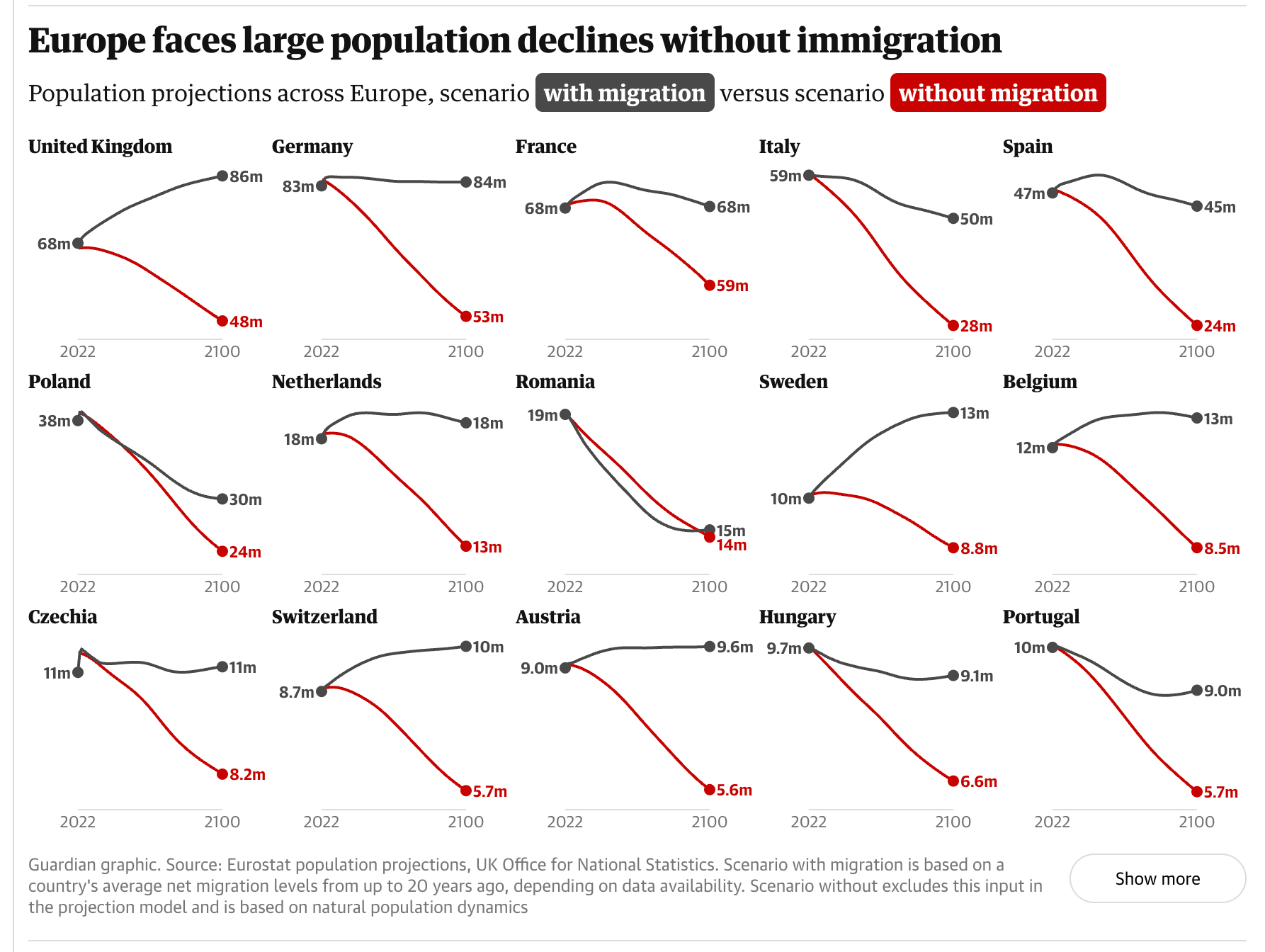
Image of the week:
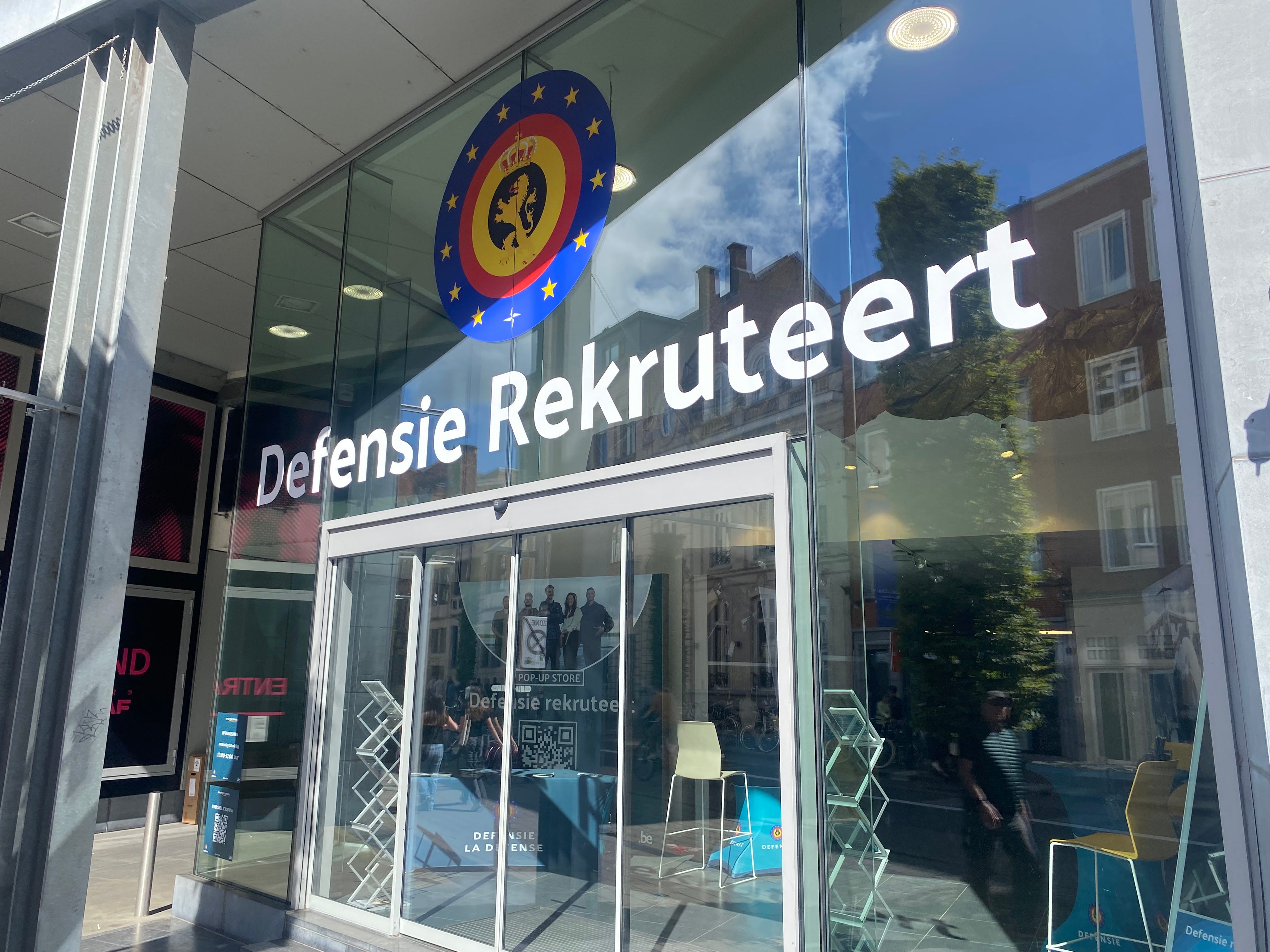
Recruiting for the Armed Forces in Belgium is up, as it is across Europe. European nations are trying to increase personnel sizes as they pour more money into defense to comply with the Trump-driven 5 percent of GDP spending targets. This is the outside of a new recruiting center that popped up on a busy street in the student city of Leuven, Belgium. Still, the Belgian army is tiny compared to neighbors — it’s projected to have only 29,000 soldiers and civilians by 2029.
What I’m reading on transatlanticism
EUROPE’S DADDY PROBLEM — In his most recent post Dave Keating argues that American cultural imperialism has set the stage for European passivity towards the Trump administration’s aggression towards the European Union. The post is an excerpt from Keating’s upcoming November book. He writes, America “also owns the European mind, through 75 years of cultural imperialism that has made Europeans feel that they are somehow part of America - or at least on the outer colonial fringes of an American empire.”
DRAGHI v. VON DER LEYEN — La Matinale Européenne published a smart piece of analysis last week contextualizing the tensions between Mario Draghi’s and Ursula von der Leyen’s vision for the European Union. “C'est le but de cette réflexion: remobiliser les européens,” writes La Matinale. “It’s the goal of this reflection: to remobilise the Europeans.” (In French, but easily translated for Anglophones.)
Poll
LANGUAGES — I typically hear plenty of French, English and Dutch, and a smattering of German and Arabic. Spanish, Italian, and Polish often make appearances too.
Jim Jordan’s Irish friend: “Europe wants to be the global leader for online censorship.”
Farage: “awful, authoritarian situation.”
…Headline from the Ohio Capital Journal: “Ohio Republicans pass pornography age verification ID law as part of state budget.”
I love me a good contradiction!